Cost control
2026 SaaS Spending Benchmarks: Are You Overpaying?
This benchmark guide helps founders and ops leads judge whether their software spend looks lean, normal, or inflated for their size. It focuses on the team-size jump most generic SMB reports blur together: 1 to 10 employees versus 11 to 50.


8 min. read
TL;DR
Most startups should treat $4,800 to $5,600 per employee per year as a broad market benchmark.
That is a useful starting point, but it hides big differences between a five-person team and a forty-person team.
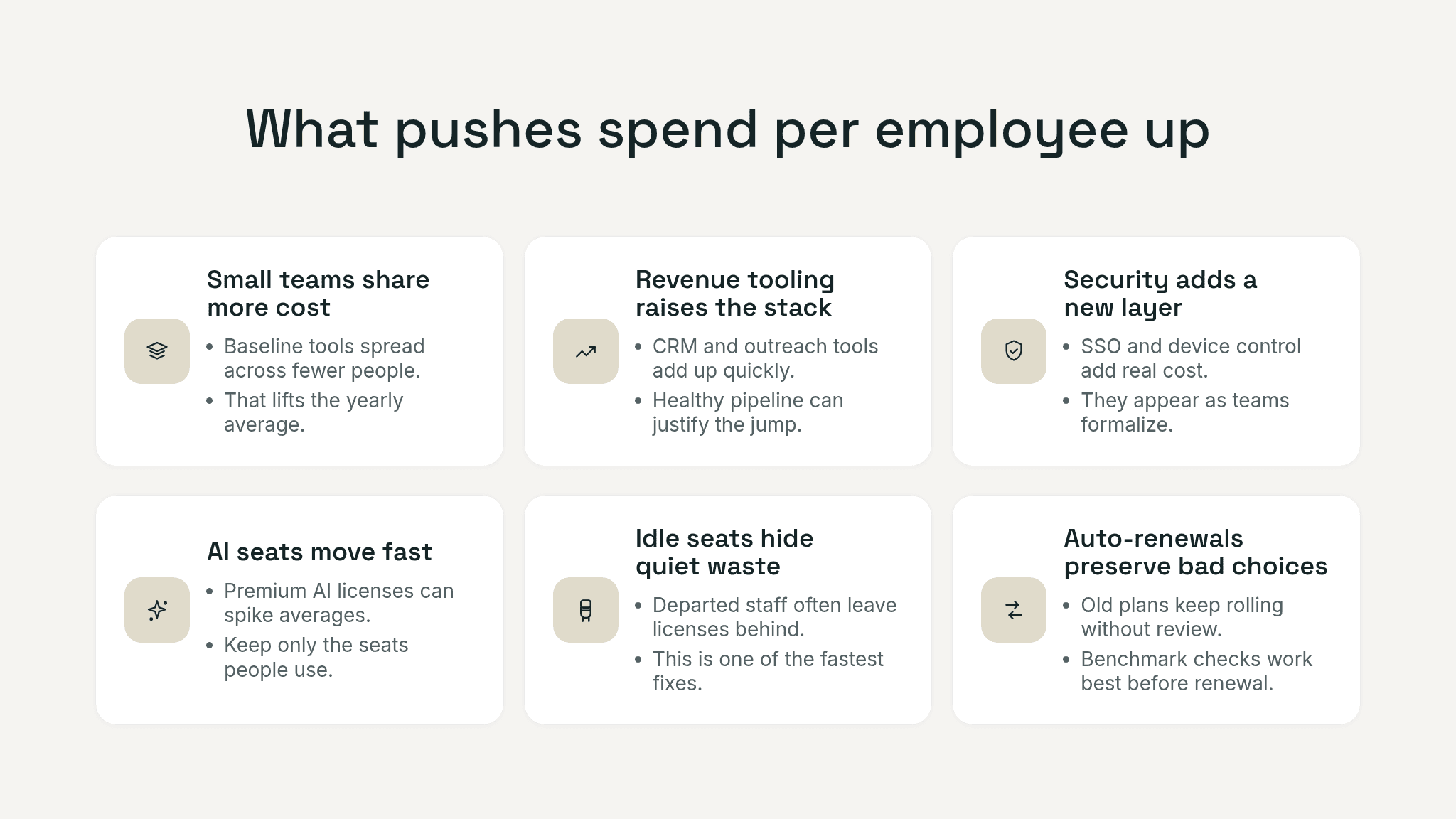
Very small teams usually pay more per employee.
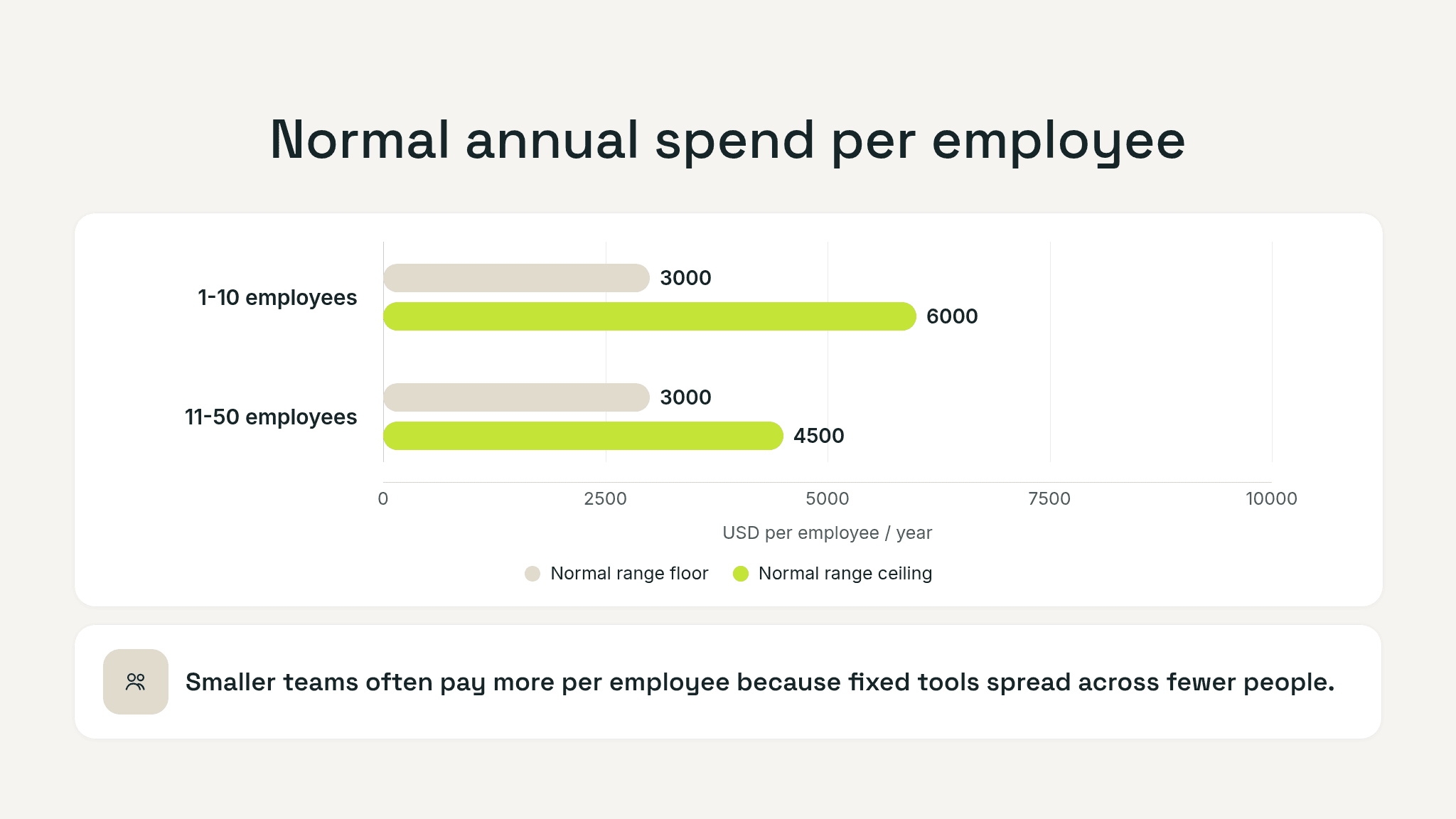
Fixed tool costs get spread across fewer people, so a 1 to 10 person startup can look expensive on a per-employee basis without doing anything reckless.
The red flag is not just a high number.
It is high spend combined with weak ownership, duplicate tools, unused seats, or SaaS taking an outsized share of operating expenses.
Benchmarks are only useful if they lead to action.
If your spend looks heavy, review seats, categories, renewals, and owner accountability before you start cutting tools people genuinely need.


Track your SaaS spend
Get full visibility into subscriptions, owners, and upcoming renewals.

SaaS spend benchmarks for startups with 11 to 50 employees
Once a startup grows past the micro-team stage, the picture changes.
Per-employee spend often becomes more efficient because core shared tooling is spread across more people. At the same time, the stack gets broader. You add recruiting, security, finance, customer success, product analytics, and role-specific apps. Total spend rises, but per-employee cost often stabilizes instead of exploding.
For startups in the 11 to 50 employee range, a practical benchmark is usually:
$3,000 to $4,500 per employee per year for a relatively lean stack
$4,500 to $6,500 per employee per year for a normal but more mature tool mix
$6,500+ per employee per year when complexity, compliance, sales tooling, or heavy AI adoption starts pushing the stack upward
This is where the comparison gets useful. If a 30-person startup is spending more per employee than a five-person startup with similar complexity, that is worth scrutinizing. At this size, economies of scale should be helping you, not disappearing.
The most common reasons spend stays too high at 11 to 50 employees are not exotic. They are usually boring:
duplicate tools across departments
extra seats that survived hiring changes
overlapping reporting or productivity tools
pricing plans that were never renegotiated after the company grew
new software added without retiring old software
This is also the range where “software cost per user” becomes easier to track category by category. A sales team may justify a higher per-user stack than an operations team. That is fine. The important thing is understanding where the cost concentration sits.
A quick benchmark table for lean startups
Team size | Lean range | Normal range | Watch closely | Likely overpaying |
1 to 10 employees | Under $3,000 | $3,000 to $6,000 | $6,000 to $8,000 | Above $8,000 |
11 to 50 employees | Under $3,000 | $3,000 to $4,500 | $4,500 to $6,500 | Above $6,500 to $7,000+ |
Use this as a judgment tool, not a rigid rule.
If your number is high because you are sales-heavy, security-heavy, or running a tool-intensive product org, that may be rational. If nobody can explain where the money goes, that is different.

Still tracking this manually?
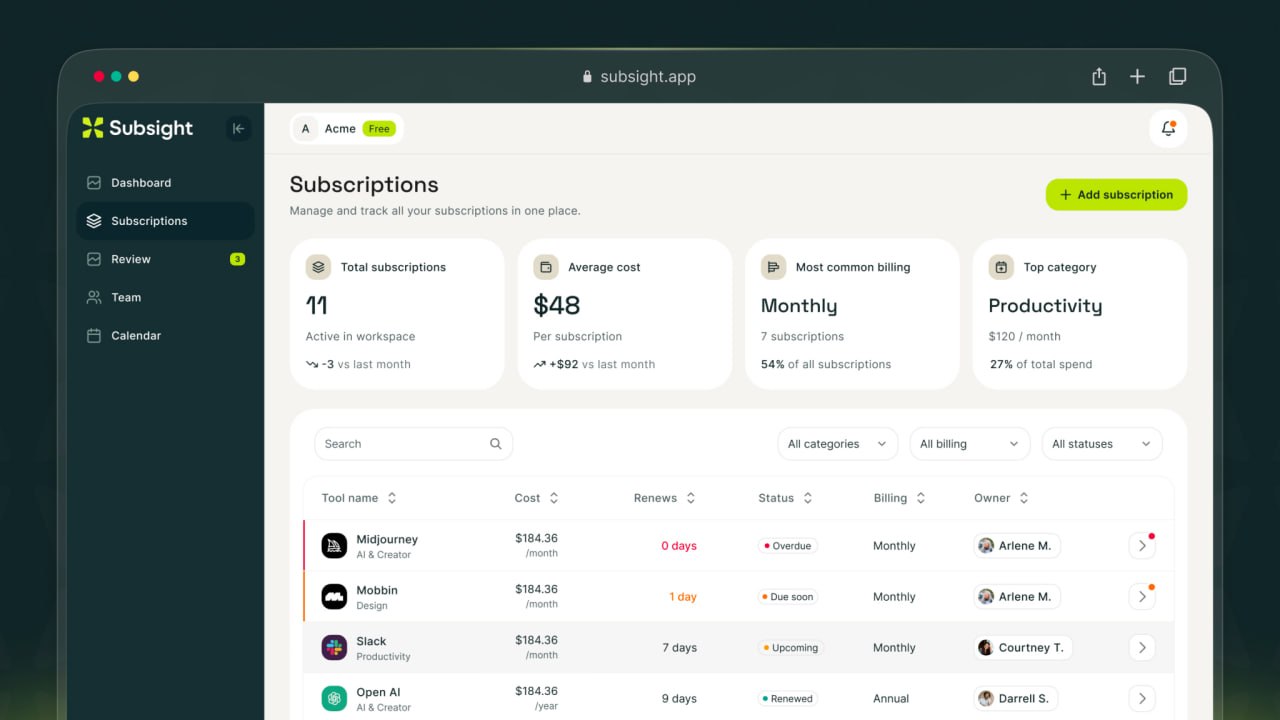
Subsight automatically maps your tools, owners, and renewal timelines in one place.
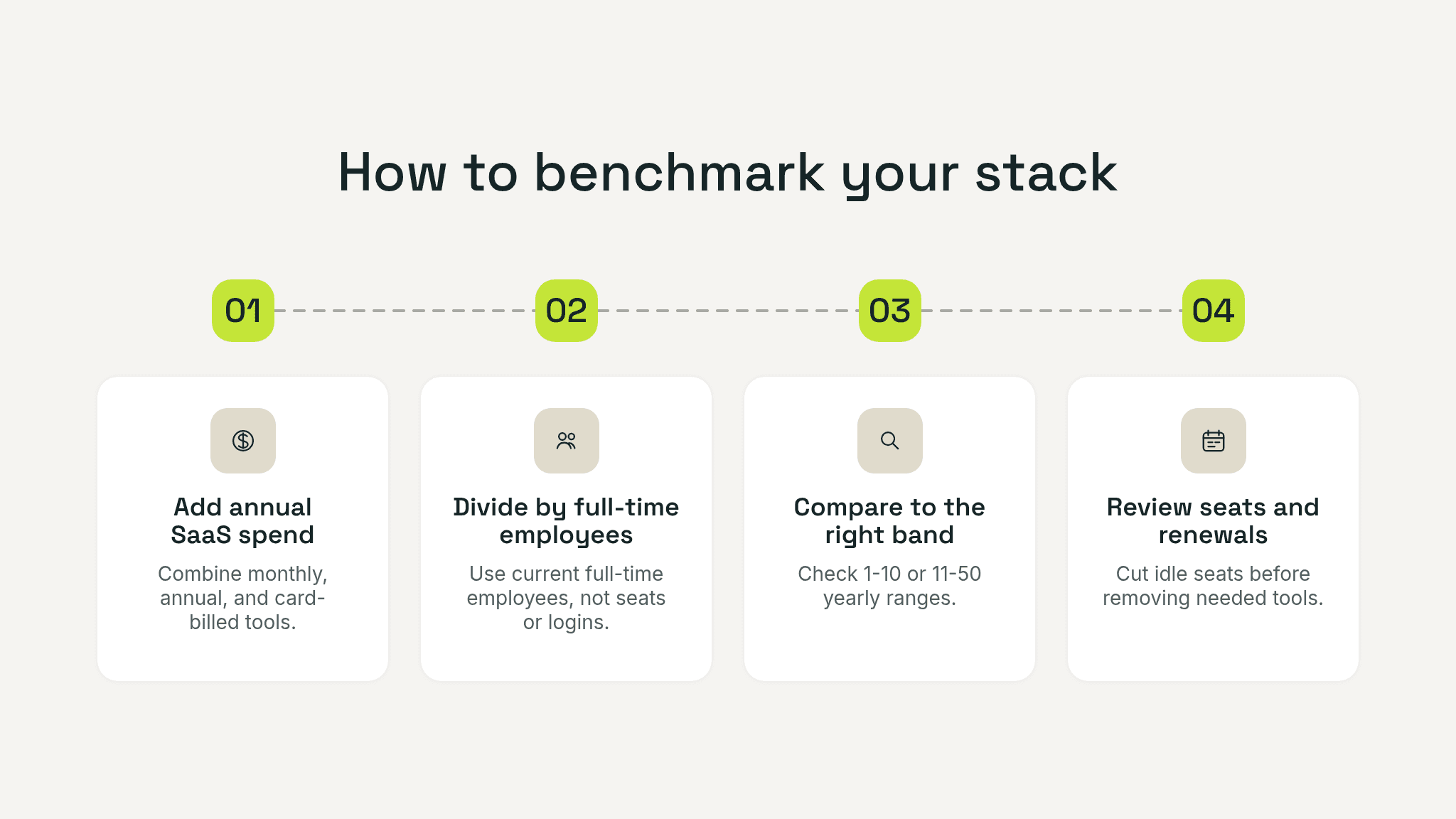

Pro Tip: Run the benchmark twice: once on your full annual SaaS spend, and once on only the contracts renewing in the next 90 days. The second cut shows where a heavy stack is about to lock itself in again, which is usually where the fastest practical savings sit.
Use the benchmark to ask better questions
A five-person startup can look expensive and still be fine. A thirty-person startup can sit near the average and still waste a meaningful amount of money. The benchmark matters because it forces better questions. Are we paying for leverage or drift? Did this stack grow intentionally, or did it just happen?
If you can answer those questions clearly, you are probably not overpaying. If you cannot, the benchmark is doing its job by telling you where to look next.

Take control of your SaaS stack
Stop guessing. Know exactly what you’re paying for and who owns it.
Frequently asked questions
What is the average SaaS spend per employee?
How much should a 10-person startup spend on software?
Why do very small teams pay more per employee?
What is a red flag that we are overpaying?
Should we cut tools if our benchmark looks high?


Petras Nargela

Petras is the Founder of Subsight and a veteran entrepreneur with over 10+ years of experience building and scaling digital ventures. Over the past decade, he has co-founded several successful companies that generate 7-figure annual revenue, including a Shopify app studio and a digital agency. Having managed the complex financial stacks of multiple high-growth businesses, he built Subsight to solve the "SaaS leakage" problem he experienced firsthand. He now helps B2B teams turn software chaos into a strategic, automated advantage.