Cost control

The $50k Silent Burn: Startup SaaS Waste Statistics

Early-stage startups often overspend on software without realizing it. This guide explains where SaaS waste comes from, what the latest data shows, and how founders and ops leads can quickly reduce hidden burn without adding complexity.

Mar 2, 2026

9 min. read

Blog thumbnail with dark background displaying the title “Startup SaaS Waste Statistics” and a minimal analytics-style icon.
No headings found in content area

TL;DR: Startup SaaS waste at a glance

  • The $50k leak is real
    Early-stage startups regularly waste $20k to $50k per year on software. The main drivers are unused licenses, duplicate tools, shadow IT, and auto-renewals that roll forward quietly. Even lean teams with modest stacks are exposed.

  • Waste hides in plain sight
    General accounting shows what was paid, not whether anyone is using the tool. Without visibility into seats, owners, and renewal dates, ghost spend builds month after month with no clear trigger to review it. Many teams first encounter this problem while trying to find hidden monthly subscriptions.

  • Small fixes create immediate ROI
    A simple SaaS inventory, a 30-day inactivity rule, and tighter renewal tracking can recover meaningful runway within 30 to 60 days. None of this requires a finance team or complex tooling.

  • Visibility beats optimization
    Startups do not need enterprise procurement workflows. They need a current, centralized view of software spend across cards, invoices, and teams, similar to approaches outlined in our guide on the best subscription tracker.

  • Subsight’s role
    Subsight automatically surfaces SaaS subscriptions and renewal risk from financial data, replacing manual spreadsheets and one-off audits with continuous visibility across teams such as IT & Ops teams and finance teams.
Why early-stage startups quietly waste up to $50k on SaaS

Early-stage startups typically waste $20k to $50k per year on SaaS due to unused licenses, duplicate tools adopted by different teams, and renewals that continue without review. Accounting systems record payments but not usage, so ghost spend accumulates quietly until burn rate pressure exposes the problem.

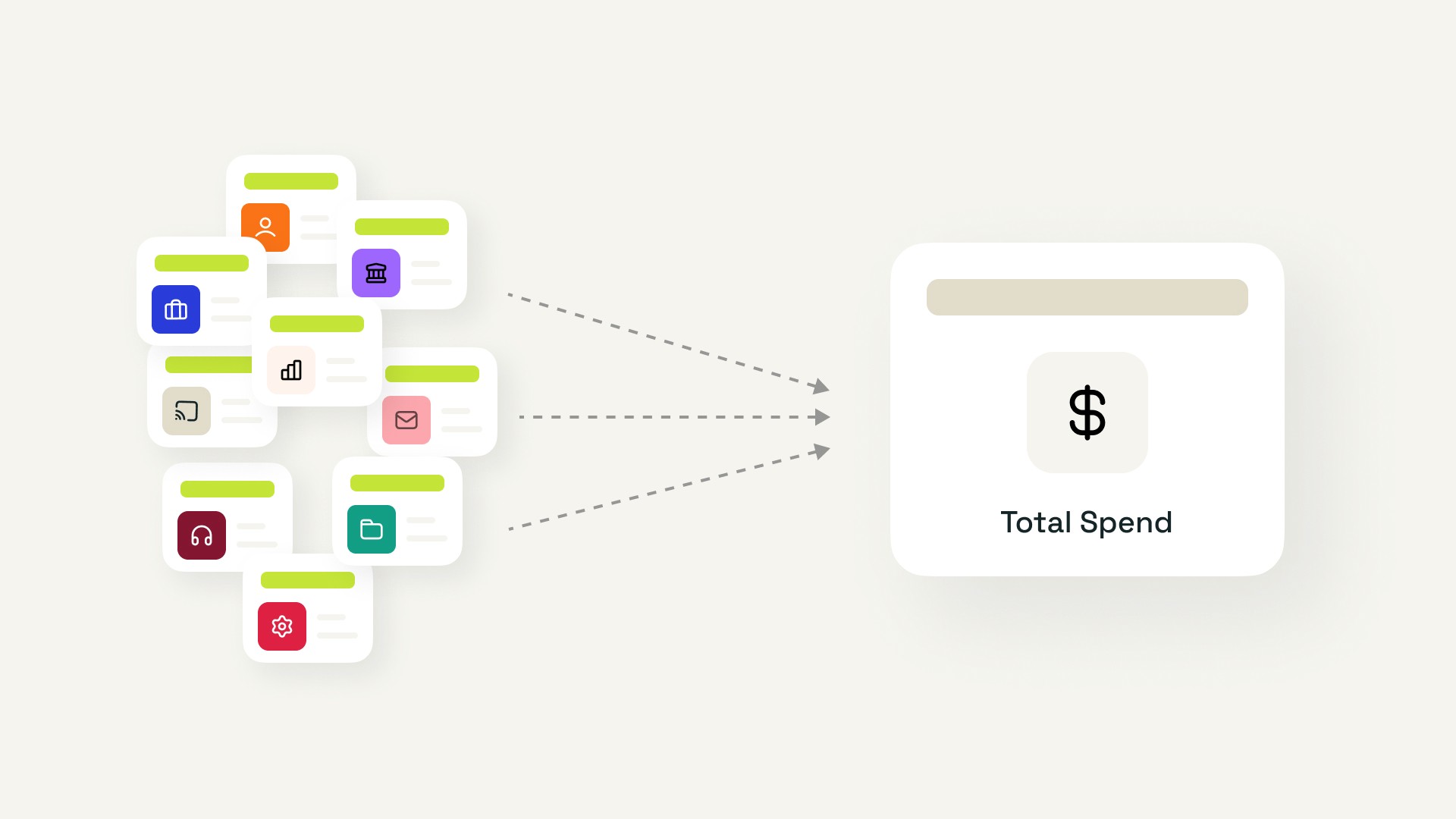
Diagram showing many small SaaS subscriptions combining into one large total software cost.

The silent burn nobody sees until runway shrinks

SaaS rarely feels expensive in isolation. A few tools at $20 or $50 per seat seem harmless because each solves an immediate problem. Over time, subscriptions accumulate across teams, cards, and renewal cycles, causing spend to grow quietly, often faster than headcount.

Why SaaS spend feels small until it isn’t

Each team adopts tools independently. Monthly pricing masks annual impact, so small decisions compound into meaningful burn without a clear signal to review costs.

The accidental admin problem

In early-stage startups, SaaS ownership is informal. Founders or ops leads track invoices alongside everything else, leaving little time to monitor usage or upcoming renewals, a common challenge for small businesses and remote teams.

Startup reality vs finance theory

Enterprise finance assumes structured procurement and oversight. Startups prioritize speed, which creates visibility gaps long before costs feel urgent.

Enterprise complexity vs startup speed

Enterprise approach

Startup reality

Procurement workflows

Instant card purchases

Dedicated owners

Shared responsibility

Approval chains

Fast tool adoption

Renewal governance

Limited visibility

Startup SaaS waste statistics: what the data actually shows

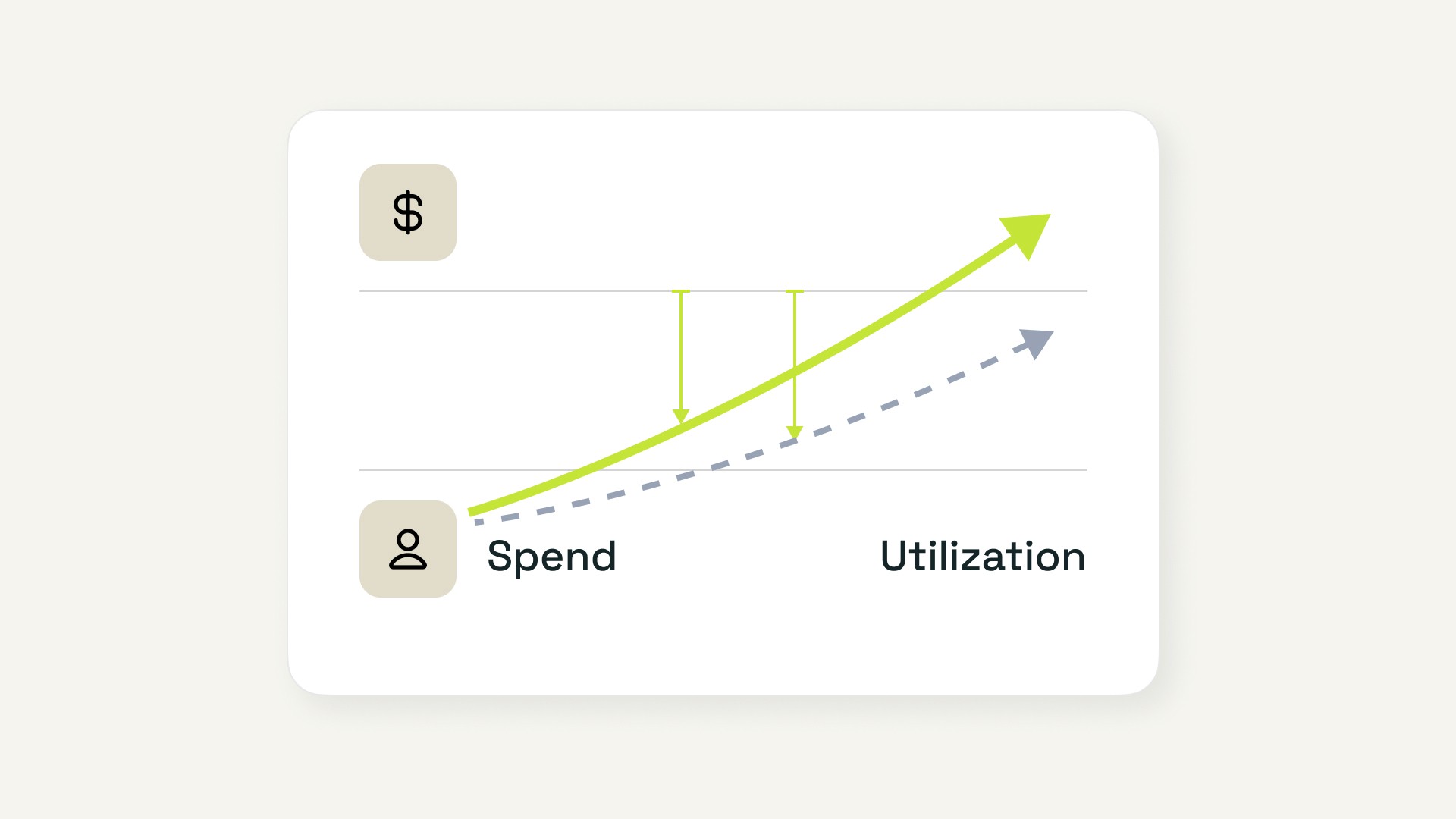
Industry data consistently shows the same trend: SaaS spending is rising quickly while utilization lags behind, according to benchmarks from Statista and the Zylo SaaS Management Index.

Line comparison showing software spending increasing faster than software usage.

Average startup software spend per employee

Recent benchmarks place SaaS spend per employee in the range of several thousand dollars annually, even for smaller companies. As teams adopt collaboration, analytics, AI, and operational tools early, software becomes a meaningful operating expense long before formal finance processes exist.

The 30 to 50 percent unused license benchmark

Research consistently finds that organizations use only about half of the licenses they purchase, a trend highlighted in reports by Zylo SaaS Management Index.

Why $50k per year is a plausible number

A 25-person startup spending roughly $3k per employee annually reaches $75k in total SaaS spend. If 30 to 50 percent delivers little or no value, waste alone can approach $20k to $40k. Add duplicate tools and missed renewals, and $50k becomes realistic.

SaaS waste breakdown

Source of waste

Typical impact

Unused licenses

30 to 50 percent of seats

Duplicate tools

Overlapping subscriptions across teams

Tier overpayment

Paying for unused premium features

Auto-renewals

Costs continue without review

Why early-stage startups quietly waste up to $50k on SaaS

Early-stage startups typically waste $20k to $50k per year on SaaS due to unused licenses, duplicate tools adopted by different teams, and renewals that continue without review. Accounting systems record payments but not usage, so ghost spend accumulates quietly until burn rate pressure exposes the problem.

Diagram showing many small SaaS subscriptions combining into one large total software cost.

The silent burn nobody sees until runway shrinks

SaaS rarely feels expensive in isolation. A few tools at $20 or $50 per seat seem harmless because each solves an immediate problem. Over time, subscriptions accumulate across teams, cards, and renewal cycles, causing spend to grow quietly, often faster than headcount.

Why SaaS spend feels small until it isn’t

Each team adopts tools independently. Monthly pricing masks annual impact, so small decisions compound into meaningful burn without a clear signal to review costs.

The accidental admin problem

In early-stage startups, SaaS ownership is informal. Founders or ops leads track invoices alongside everything else, leaving little time to monitor usage or upcoming renewals, a common challenge for small businesses and remote teams.

Startup reality vs finance theory

Enterprise finance assumes structured procurement and oversight. Startups prioritize speed, which creates visibility gaps long before costs feel urgent.

Enterprise complexity vs startup speed

Enterprise approach

Startup reality

Procurement workflows

Instant card purchases

Dedicated owners

Shared responsibility

Approval chains

Fast tool adoption

Renewal governance

Limited visibility

Startup SaaS waste statistics: what the data actually shows

Industry data consistently shows the same trend: SaaS spending is rising quickly while utilization lags behind, according to benchmarks from Statista and the Zylo SaaS Management Index.

Line comparison showing software spending increasing faster than software usage.

Average startup software spend per employee

Recent benchmarks place SaaS spend per employee in the range of several thousand dollars annually, even for smaller companies. As teams adopt collaboration, analytics, AI, and operational tools early, software becomes a meaningful operating expense long before formal finance processes exist.

The 30 to 50 percent unused license benchmark

Research consistently finds that organizations use only about half of the licenses they purchase, a trend highlighted in reports by Zylo SaaS Management Index.

Why $50k per year is a plausible number

A 25-person startup spending roughly $3k per employee annually reaches $75k in total SaaS spend. If 30 to 50 percent delivers little or no value, waste alone can approach $20k to $40k. Add duplicate tools and missed renewals, and $50k becomes realistic.

SaaS waste breakdown

Source of waste

Typical impact

Unused licenses

30 to 50 percent of seats

Duplicate tools

Overlapping subscriptions across teams

Tier overpayment

Paying for unused premium features

Auto-renewals

Costs continue without review

See your SaaS footprint

Get visibility into subscriptions, renewals, and decentralized spend.

Join 100+ founders in line

Where startup money actually leaks

Most SaaS waste does not come from a single bad decision. It builds gradually through normal startup behavior. Teams move fast, tools solve immediate problems, and oversight arrives later. By the time spend is reviewed, several small leaks are already active.

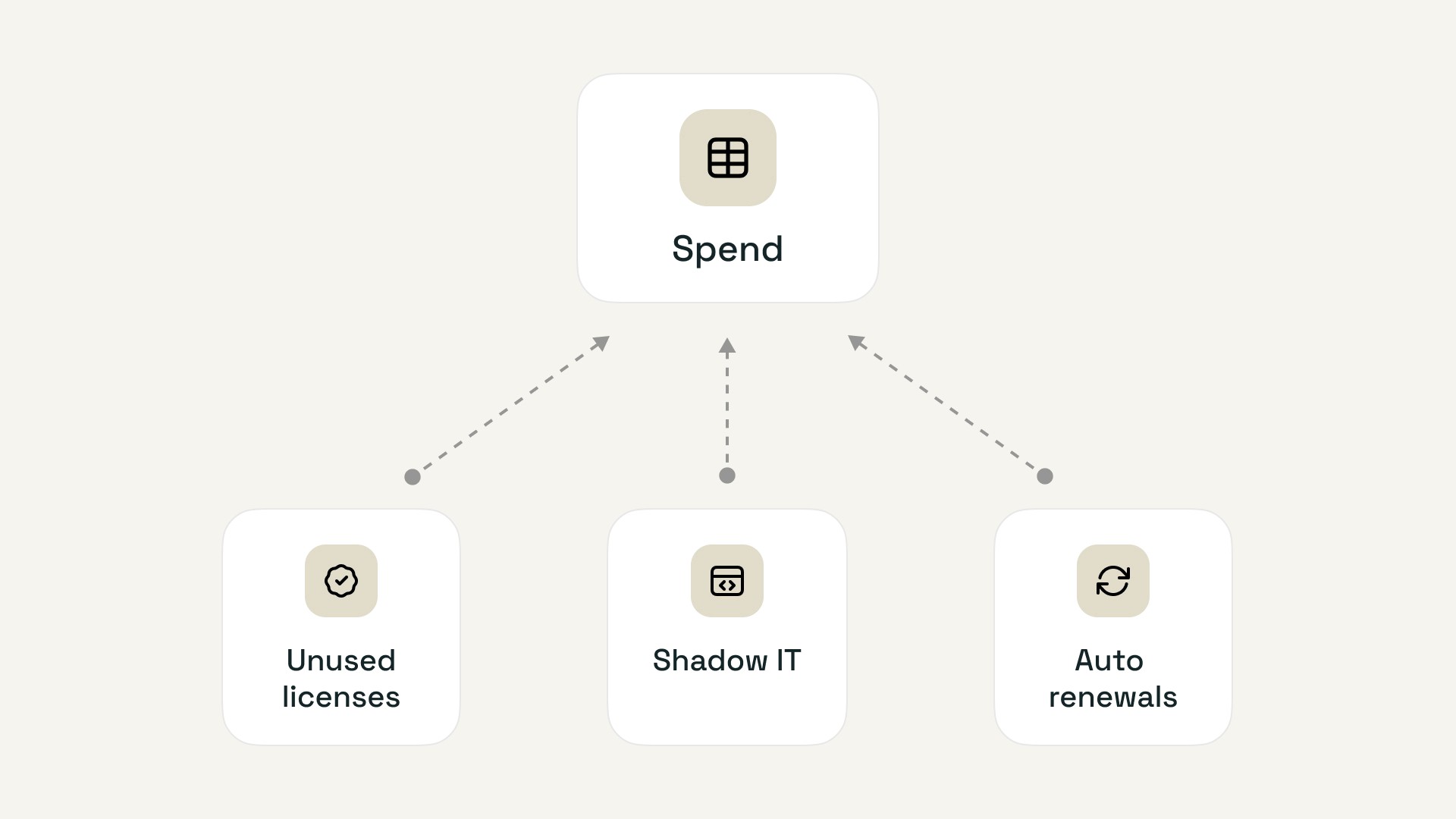
Diagram showing unused licenses, shadow IT, and renewals feeding into total software waste.

Unused and over-sized licenses

Licenses are often purchased ahead of hiring plans or left active after role changes. Employees leave, teams restructure, and seats remain assigned. Many startups also upgrade tiers for a single feature, then continue paying for capabilities rarely used. Individually these costs look small, but together they create steady recurring waste.

Shadow IT: the quiet multiplier

Shadow IT appears when employees adopt tools outside a centralized process. Studies referenced by Dashlane security research show unmanaged apps are common even in small organizations. A marketer subscribes to analytics software, a designer tests a collaboration tool, or an engineer pays for infrastructure monitoring on a company card.

These tools often duplicate existing capabilities. Without visibility, companies pay multiple times to solve the same problem.

Auto-renewals and renewal blind spots

Most SaaS contracts renew automatically. Without renewal tracking, companies miss cancellation or renegotiation windows. Prices increase while usage stays flat, causing spend to grow even when the team size does not.

Common leak patterns

  • Licenses kept for inactive users

  • Duplicate tools across departments

  • Premium tiers purchased for limited features

  • Trials converted into paid plans unnoticed

  • Annual renewals reviewed too late

The startup contrast

  • Enterprise: procurement workflows, approvals, vendor governance

  • Startup: card payments, fast adoption, zero visibility

Quick wins: reduce SaaS burn rate in 30 to 60 days

Reducing SaaS waste does not require a finance overhaul. Most startups can recover savings quickly by improving visibility and adding a few lightweight habits. The goal is clarity, not strict control, especially for operational teams like agencies.

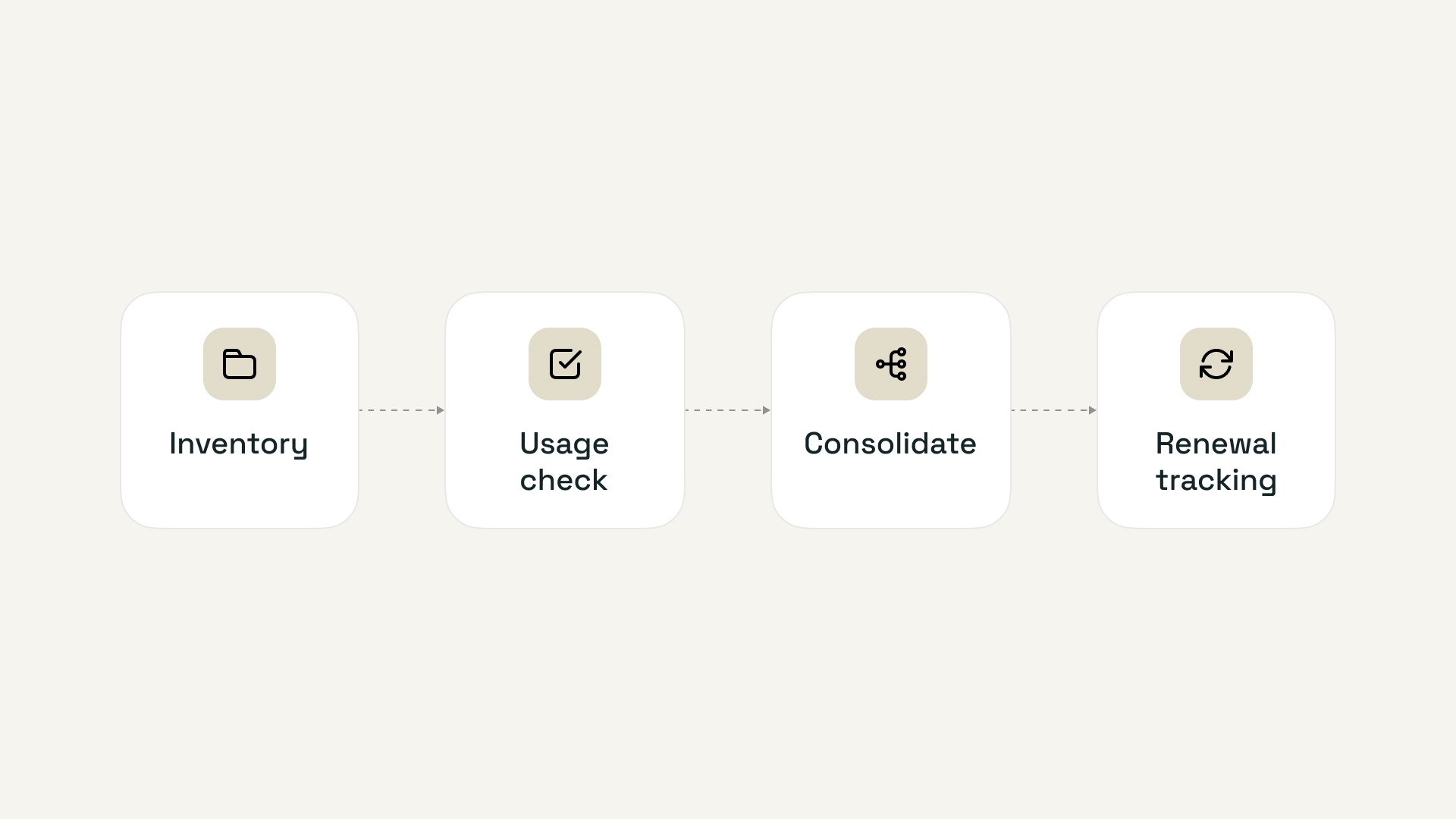
Workflow diagram showing steps to identify and reduce unnecessary software subscriptions.

Build a one-page SaaS inventory

Start with a simple source of truth, similar to the workflow described in our guide on how to find hidden monthly subscriptions. A single spreadsheet is enough to reveal gaps and overlaps once everything is listed in one place. Pull data from card statements, invoices, and team leads instead of waiting for perfect accuracy.

Minimum fields to track

  • Tool name

  • Owner or responsible team

  • Plan or tier

  • Number of seats

  • Monthly or annual cost

  • Renewal date

  • Payment source

  • Last known usage

Apply the 30-day login rule

Unused licenses are often the fastest savings opportunity. If a user has not logged in recently, the license likely does not need to remain active.

License reclaim workflow

  • Export user activity from major tools

  • Identify accounts inactive for 30 days

  • Downgrade or remove unused seats

  • Store reclaimed licenses for future hires

  • Review again monthly

Kill duplicates by problem, not tool

Teams naturally adopt overlapping solutions. Instead of evaluating tools individually, group them by job to be done and choose a default platform.

Consolidation playbook

  • List tools by category or function

  • Identify overlapping capabilities

  • Select one primary tool per category

  • Sunset or restrict alternatives

  • Reevaluate after one billing cycle

Add guardrails without slowing teams down

Control should not block experimentation. Simple visibility rules prevent uncontrolled growth while keeping teams flexible.

Lightweight governance rules

  • Anyone can trial a tool

  • Payment requires logging the tool centrally

  • Assign an owner for each subscription

  • Review new tools during monthly ops check-ins

  • Track renewals on a shared calendar

Where startup money actually leaks

Most SaaS waste does not come from a single bad decision. It builds gradually through normal startup behavior. Teams move fast, tools solve immediate problems, and oversight arrives later. By the time spend is reviewed, several small leaks are already active.

Diagram showing unused licenses, shadow IT, and renewals feeding into total software waste.

Unused and over-sized licenses

Licenses are often purchased ahead of hiring plans or left active after role changes. Employees leave, teams restructure, and seats remain assigned. Many startups also upgrade tiers for a single feature, then continue paying for capabilities rarely used. Individually these costs look small, but together they create steady recurring waste.

Shadow IT: the quiet multiplier

Shadow IT appears when employees adopt tools outside a centralized process. Studies referenced by Dashlane security research show unmanaged apps are common even in small organizations. A marketer subscribes to analytics software, a designer tests a collaboration tool, or an engineer pays for infrastructure monitoring on a company card.

These tools often duplicate existing capabilities. Without visibility, companies pay multiple times to solve the same problem.

Auto-renewals and renewal blind spots

Most SaaS contracts renew automatically. Without renewal tracking, companies miss cancellation or renegotiation windows. Prices increase while usage stays flat, causing spend to grow even when the team size does not.

Common leak patterns

  • Licenses kept for inactive users

  • Duplicate tools across departments

  • Premium tiers purchased for limited features

  • Trials converted into paid plans unnoticed

  • Annual renewals reviewed too late

The startup contrast

  • Enterprise: procurement workflows, approvals, vendor governance

  • Startup: card payments, fast adoption, zero visibility

Quick wins: reduce SaaS burn rate in 30 to 60 days

Reducing SaaS waste does not require a finance overhaul. Most startups can recover savings quickly by improving visibility and adding a few lightweight habits. The goal is clarity, not strict control, especially for operational teams like agencies.

Workflow diagram showing steps to identify and reduce unnecessary software subscriptions.

Build a one-page SaaS inventory

Start with a simple source of truth, similar to the workflow described in our guide on how to find hidden monthly subscriptions. A single spreadsheet is enough to reveal gaps and overlaps once everything is listed in one place. Pull data from card statements, invoices, and team leads instead of waiting for perfect accuracy.

Minimum fields to track

  • Tool name

  • Owner or responsible team

  • Plan or tier

  • Number of seats

  • Monthly or annual cost

  • Renewal date

  • Payment source

  • Last known usage

Apply the 30-day login rule

Unused licenses are often the fastest savings opportunity. If a user has not logged in recently, the license likely does not need to remain active.

License reclaim workflow

  • Export user activity from major tools

  • Identify accounts inactive for 30 days

  • Downgrade or remove unused seats

  • Store reclaimed licenses for future hires

  • Review again monthly

Kill duplicates by problem, not tool

Teams naturally adopt overlapping solutions. Instead of evaluating tools individually, group them by job to be done and choose a default platform.

Consolidation playbook

  • List tools by category or function

  • Identify overlapping capabilities

  • Select one primary tool per category

  • Sunset or restrict alternatives

  • Reevaluate after one billing cycle

Add guardrails without slowing teams down

Control should not block experimentation. Simple visibility rules prevent uncontrolled growth while keeping teams flexible.

Lightweight governance rules

  • Anyone can trial a tool

  • Payment requires logging the tool centrally

  • Assign an owner for each subscription

  • Review new tools during monthly ops check-ins

  • Track renewals on a shared calendar

See your SaaS exposure

Map subscriptions, renewals, and duplicate tools across existing spend.

Join 100+ founders in line

The Subsight shortcut

Most startups attempt a manual SaaS audit at some point, exporting statements and compiling spreadsheets to understand spend. The process works briefly but becomes outdated as new tools appear and renewals continue. Teams exploring automation typically begin from the features overview to understand how subscription discovery works.

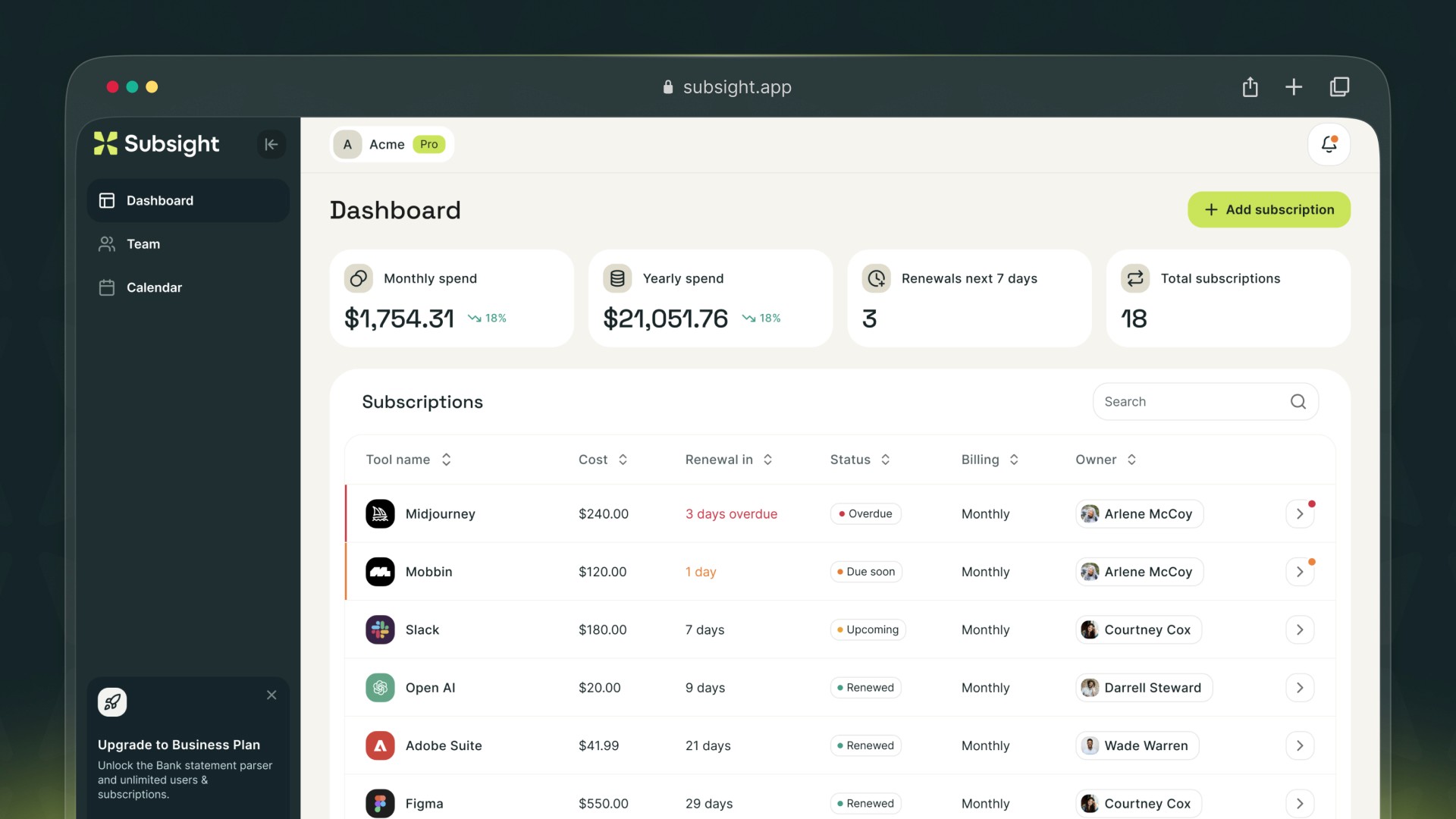
Subsight dashboard displaying SaaS subscriptions, renewal dates, spend totals, vendor names, and ownership tracking.

Automating the manual audit

Instead of rebuilding inventories every quarter, Subsight continuously identifies subscriptions directly from financial data. This removes the need to manually collect receipts or chase teams for updates.

Finding ghost spend accounting misses

Accounting systems confirm transactions but do not group or interpret software spend. Subsight surfaces subscriptions, duplicate tools, and inactive spend patterns that are difficult to spot inside raw statements.

Renewal visibility without finance overhead

Renewal tracking becomes automatic, helping teams see upcoming commitments early enough to review or cancel.

Manual process vs Subsight

Task

Manual approach

Subsight

Subscription discovery

Manual search

Automatic detection

Renewal tracking

Calendar reminders

Centralized visibility

Spend overview

Static spreadsheet

Continuously updated view

The startup contrast

  • Enterprise tools: heavy integrations, long onboarding

  • Subsight: upload statements → instant SaaS visibility

Why we built Subsight: the SaaS waste gap

Subsight emerged from a common startup frustration: teams knew software costs were rising but lacked a reliable way to see the full picture without hours of manual work. The issue was not missing data, but missing visibility, which shaped how we designed the product described on our About Us page.

The old way: spreadsheets, exports, and guesswork

Most startups rely on spreadsheets built from bank exports and invoice searches. These snapshots become outdated quickly. Ownership is unclear, renewals are missed, and each audit starts from scratch instead of building on a living system.

The visibility problem before finance teams exist

Early-stage companies rarely have dedicated finance or IT operations. Founders and ops leads manage subscriptions alongside hiring, product work, and growth. Without lightweight tooling, SaaS oversight becomes reactive rather than continuous.

Building for startup speed, not procurement bureaucracy

Enterprise solutions assume structured procurement and complex integrations. Subsight was designed for startups that need immediate clarity without adding process overhead or slowing how teams adopt new tools.

How SaaS waste directly impacts burn rate

SaaS waste rarely appears as one large expense. Instead, it quietly increases monthly operating costs and shortens runway without immediate visibility. Because spending is distributed across teams and tools, its impact is often underestimated until budgets tighten.

Illustration showing software subscriptions gradually reducing a startup runway timeline.

The hidden runway equation

Every recurring subscription increases fixed costs. When unused tools remain active, startups effectively reduce runway without gaining productivity or growth in return.

Waste vs hiring tradeoffs

Recovered SaaS spend often equals meaningful operational capacity. Savings from unused licenses can fund contractors, marketing experiments, or extend hiring timelines without raising additional capital.

Why founders feel the pain late

The effect becomes visible only when cash forecasts tighten. By then, renewals have compounded and cancellations feel reactive rather than strategic.

Burn rate impact examples

Monthly waste

Annual waste

Runway impact (at $100k burn/month)

$1,500

$18,000

~5 extra days runway

$3,000

$36,000

~11 extra days runway

$4,000

$48,000

~14 extra days runway

The Subsight shortcut

Most startups attempt a manual SaaS audit at some point, exporting statements and compiling spreadsheets to understand spend. The process works briefly but becomes outdated as new tools appear and renewals continue. Teams exploring automation typically begin from the features overview to understand how subscription discovery works.

Subsight dashboard displaying SaaS subscriptions, renewal dates, spend totals, vendor names, and ownership tracking.

Automating the manual audit

Instead of rebuilding inventories every quarter, Subsight continuously identifies subscriptions directly from financial data. This removes the need to manually collect receipts or chase teams for updates.

Finding ghost spend accounting misses

Accounting systems confirm transactions but do not group or interpret software spend. Subsight surfaces subscriptions, duplicate tools, and inactive spend patterns that are difficult to spot inside raw statements.

Renewal visibility without finance overhead

Renewal tracking becomes automatic, helping teams see upcoming commitments early enough to review or cancel.

Manual process vs Subsight

Task

Manual approach

Subsight

Subscription discovery

Manual search

Automatic detection

Renewal tracking

Calendar reminders

Centralized visibility

Spend overview

Static spreadsheet

Continuously updated view

The startup contrast

  • Enterprise tools: heavy integrations, long onboarding

  • Subsight: upload statements → instant SaaS visibility

Why we built Subsight: the SaaS waste gap

Subsight emerged from a common startup frustration: teams knew software costs were rising but lacked a reliable way to see the full picture without hours of manual work. The issue was not missing data, but missing visibility, which shaped how we designed the product described on our About Us page.

The old way: spreadsheets, exports, and guesswork

Most startups rely on spreadsheets built from bank exports and invoice searches. These snapshots become outdated quickly. Ownership is unclear, renewals are missed, and each audit starts from scratch instead of building on a living system.

The visibility problem before finance teams exist

Early-stage companies rarely have dedicated finance or IT operations. Founders and ops leads manage subscriptions alongside hiring, product work, and growth. Without lightweight tooling, SaaS oversight becomes reactive rather than continuous.

Building for startup speed, not procurement bureaucracy

Enterprise solutions assume structured procurement and complex integrations. Subsight was designed for startups that need immediate clarity without adding process overhead or slowing how teams adopt new tools.

How SaaS waste directly impacts burn rate

SaaS waste rarely appears as one large expense. Instead, it quietly increases monthly operating costs and shortens runway without immediate visibility. Because spending is distributed across teams and tools, its impact is often underestimated until budgets tighten.

Illustration showing software subscriptions gradually reducing a startup runway timeline.

The hidden runway equation

Every recurring subscription increases fixed costs. When unused tools remain active, startups effectively reduce runway without gaining productivity or growth in return.

Waste vs hiring tradeoffs

Recovered SaaS spend often equals meaningful operational capacity. Savings from unused licenses can fund contractors, marketing experiments, or extend hiring timelines without raising additional capital.

Why founders feel the pain late

The effect becomes visible only when cash forecasts tighten. By then, renewals have compounded and cancellations feel reactive rather than strategic.

Burn rate impact examples

Monthly waste

Annual waste

Runway impact (at $100k burn/month)

$1,500

$18,000

~5 extra days runway

$3,000

$36,000

~11 extra days runway

$4,000

$48,000

~14 extra days runway

Pro Tip: Most founders review SaaS costs only when budgets tighten, which limits their options. Instead, check upcoming renewals once a month. The best leverage exists before renewal dates, not after payment. A shared renewal calendar often uncovers savings long before cancellations become necessary.

Signs your startup has ghost spend right now

Ghost spend often appears as small operational frictions before it shows up in financial reports. When visibility is low, these signals repeat across teams.

Operational warning signals

  • Teams use multiple tools for the same function

  • No clear owner for major subscriptions

  • Employees unsure which tools are officially supported

  • Licenses remain active after role changes or departures

  • New tools appear without centralized tracking

Financial warning signals

  • Software costs rise while headcount stays flat

  • Unexpected renewal charges appear

  • Difficulty explaining total SaaS spend quickly

  • Multiple small recurring charges across cards

  • Budget reviews trigger last-minute cancellations

Start with clarity

Track subscriptions and renewals before SaaS complexity accelerates.

Join 100+ founders in line

Frequently asked questions

How much do startups typically spend on SaaS per employee?

Why do startups waste money on software?

What percentage of SaaS licenses are usually unused?

How to find sneaky subscriptions?

What is shadow IT and why is it risky for startups?

No headings found in content area

Find hidden SaaS subscriptions

Track every tool, owner, and renewal in one place. No spreadsheets. No surprise renewals.

Join 100+ founders in line

Professional portrait of Petras Nargela, Founder of Subsight, against a neutral background.

Petras Nargela

Petras is the Founder of Subsight and a veteran entrepreneur with over 10+ years of experience building and scaling digital ventures. Over the past decade, he has co-founded several successful companies that generate 7-figure annual revenue, including a Shopify app studio and a digital agency. Having managed the complex financial stacks of multiple high-growth businesses, he built Subsight to solve the "SaaS leakage" problem he experienced firsthand. He now helps B2B teams turn software chaos into a strategic, automated advantage.

Get started

Affordable subscription tracking for teams

Track, manage, and cancel subscriptions in minutes. Join the waitlist today to secure 40% off your first 3 months.

Get started

Affordable subscription tracking for teams

Track, manage, and cancel subscriptions in minutes. Join the waitlist today to secure 40% off your first 3 months.

Get started

Affordable subscription tracking for teams

Track, manage, and cancel subscriptions in minutes. Join the waitlist today to secure 40% off your first 3 months.